
The idea of investing should be seen as simple and easy which everybody can do.
But the media and the finance industry, have for years dispelled fear that it’s complex, confusing and you need lots of money to get started.
Or, it’s complicated to set up a dealing or brokerage account yourself, in that you have to use a 3rd party such as a Financial Adviser.
Plus it’s costly and expensive to buy and sell stocks, shares, funds etc.
Also, we aren’t taught about investing in schools through education. Or in the workplace by our employer. So the vast majority see investing as outside our comfort zone.
Hence the reason, why most people invest in a simple Cash ISA or building society account. Because they have never been shown the basics about getting started.
However through, most people are investing unknowingly into a workplace or private pension.
So why should be idea of doing it yourself be any different.
Thanks to update in technology in recent years. Plus, the introduction of numerous readily available investing platforms and APPS.
The idea or process of investing has completely changed beyond recognition.
So now, the world of investing is now open to all, in a matter of seconds.
So let’s look at some basic steps & rules:
- Before you allocate any money or think about investing. Create a simple emergency fund, says 3 to 6 months of living expenses – held within accessible instant access account.
- Use tax-free wrappers available, such as stocks and shares ISA.
- Keep fees low and review on a regular basis.
- Automate your contributions on a regular basis.
- Diversify your investments.
- Buy and hold for the long term.
Before you start investing ask yourself 2 simple questions ?
1: Why are you investing, what is the reason ?
2: How long are you prepared to invest for ?
Are you investing to retire earlier than expected, clear the mortgage earlier, major home improvements, or build a legacy for your children etc.
If you are investing, you should put your money away for a minimum of 5 years (short term) 10 years plus (long term).
So why do people invest !
If you put money into a savings or building society account. The provider will give you a small return, which normally fails to keep up with inflation.
By investing, you are seen as taking more risk, so you should be rewarded with a greater rate of return.
The investment could go up and down in value and the rate of return is never guaranteed. But over the long term, you should receive a nice profit if invested over numerous years.
Make sure you invest in a tax-free wrapper !
In the UK, everyone can invest in tax-free wrapper called a stocks and shares ISA.
You are allowed to invest £ 20,000 per annum into a tax-free wrapper each tax-year.
So any growth, returns, dividends and gains you make and receive will remain tax-free within the ISA wrapper.
It will also simplify your admin and management.
If you holds shares and funds outside the ISA wrapper, it could be subject to capital gains tax, dividend tax etc. Which then have to payable and declared to HMRC via self-assessment or the government gateway account.
So by investing in a tax free wrapper, it proves to be very beneficial long term as your investments hopefully grow in value one the future years.
If not held in an ISA !
At present, if you make over £ 3,000 per annum it’s could be subject to capital gains tax at 18% or 24%, (dependant on you level of income during that tax year).
You can also receive dividends up to £ 500 each tax year, but anything above that level a tax charge is payable on the excess.
Which could be 10.75% (basic rate), 35.75% (higher rate) or 39.35% (additional rate)
You are responsible for paying it yourself via self-assessment, which could be a admin nightmare or timing problem.
So, its pays to put your investments in tax-free wrapper to reduce fees, taxes, and admin.
So how do I set-up a stocks and shares ISA !
To set-up a stocks and shares ISA, it should be a simple process.
Whereby you provide basic personal information such as name, DOB, address, NI number.
It could be done in a matter of minutes.
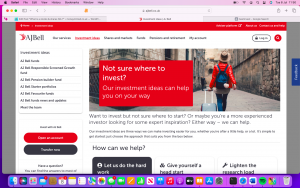
I personally use AJ BELL / Youinvest. To look after my ISA and SIPP.
They provide a very good level of service, the website is easy and user friendly.
You can buy lots of shares, funds, ETF’s etc within the tax -free wrapper.
Plus they have great sources of information to assist you. Such as monthly magazine, webinars, investment videos, investment guides, daily market reports etc.
Other companies are readily available:
If you need help, selecting your funds, they offer simple guides and recommend funds they recommend.
A simple screenshot from my provider:
What investments are on offer ?
It could be individual company stocks or shares listed on an index.
Or a collection of shares held within a fund, across lots of different investors.
So what are the main reasons for investing ?
INCOME:
You could buy an investment that pays a regular payment, such as dividend, normally quarterly, half-yearly or annually.
As the company makes profits its paid out to the shareholders.
Or it could be a bond, paying set amount of interest to the bond holder on a regular basis.
GROWTH:
With the aim of increasing your initial capital allocation, through investment gains.
As the price of your share, fund asset grows, so does your holding, known as portfolio value.
COMPOUND GROWTH:
By re-investing any dividends received, back into your holdings or portfolio.
Your portfolio will grow quicker through the power of compounding. As both your initial investment and money received will remain invested and subject to future growth returns.
So what investments are on offer ?
SHARES:
You are essentially buying a portion of that listed company. Shares are listed on the stock exchange and normally go up and down due to market sentiment.
PROS:
Share price can increase and holding increases in value. Creating a gain or profit on paper. Markets normally increase year on year, so values go up as you hold the investment for numerous years. Also provides a dividend, which compounds your returns.
CONS:
Shares prices can fall, so your investment loses value, or it could fail and you lose all your money.
The dividend could be suspended or reduced if the company is struggling, i.e failing to make a profit or suffering poor trading.
Be aware you won’t get every investment decision, neither will the professionals.
But if you are going to buy individual companies, stick to household names you know, that have been around for decades and will still be here in future years.
Do your background, research ahead of making any investment.
FUNDS:
This is a collective of numerous companies held together in a specific fund. It could include different assets classes such as shares, funds, bonds cash, commodities.
PROS:
Provides a greater form of diversification, as it holds lots of investments sectors, classes, regions.
If a certain share performs badly it won’t have such a detrimental effect as you hold numerous shares within that fund. So eliminates and spreads the risk prone by the investor.
CONS:
It could be illiquid to sell investments, within a specific fund, or you could be subject to higher fees and charges if you are paying someone to actively manage that fund.
If you need money quick you could be selling at loss. Which is what all investors are trying to avoid.
ETF’s:
Exchange traded funds trade like a share on an index. They go up and down on a daily basis.
Instead of being invested in a single company it will cover numerous shares or funds across a specific sect or region, asset class. With the aim that it tracks a set index.
PROS:
Could provide greater level of diversify across a sector or region.
The fees are normally lower than actively managed funds, due to lower operating and dealing costs. Normally the holding is held for longer period within the fund. As it makes up a small % of the market index.
CONS:
Performance could be lower than actively managed as it tracks the market. rather than trying to outperform it.
But remember most active fund managers fail to beat the market anyway.
BONDS / GILTS:
Bonds are IOU’s listed by a company to rise capital finance. Whereas GILTS are issued by government to raise finance.
In return for yo lending them money, they will pay you a return in interest at stated intervals, plus you sum of money back at the end of the completed term.
PROS:
These are considered less riskier than shares, as they have less chance to default. It is very rare for a company to fail to repay on its bonds.
It is unheard of for a major company to fail to repay back its bonds or Gilts.
So these types of assets are considered to be the safest around.
CONS:
The level of performance and return is normally lower than the stock market over many years.
They could be impacted by inflation, government uncertainty, economic events.
Plus, the vast majority of people know very little about how you buy or trade them.
In the past, they were mainly bought by traders, insurance companies, pension providers. So the big market players, as part of a de-risking plan.
INVESTMENT TRUSTS:
An investment trust is a company listed that sells shares to investors on the stock market. Which then pools the money together to buy a range of investments normally company shares or funds. Held as a collective investment.
PROS:
Greater level of return, as the trust can borrow money. Which hopefully increases the rate of return, but also the potential risk,
CONS:
The share price can fluctuate due to market supply or demand. If investors or the market feels good then prices rise, but prices could also fail.
Also, fees and charges apply each time you buy and sell a share on the open market.
How to keep it really simple !
If you are uncomfortable investing in specific shares, you can simply invest in a low cost tracker fund.
The fund will have very low fees and charges, and invest across the whole world by simply tracking the market.
As your knowledge improves you could venture into single stocks, or funds within a specific sector or region, such as FTSE 100 (top shares in the UK) or the S&P 500 (top shares in the USA)
Warren Buffett considered the worlds greatest investor, stated recently that the best thing an investor can do. Is to simply buy a low cost tracker fund, which you can just switch off and follow the market.
I personally use the Fidelity World Index fund, covers across 1300 shares over numerous companies, has fees of 0.12% and a yield of 1.12% by paying an annual dividend. The fund has produced annual return over 12% for the past 5 years and 13.5% over the past 10 years.
As a comparison the S&P 500 has produced annual return of around 8% since inception back in 1957.
If you are going to start investing, learn to avoid short term market noise, and think long term.
Don’t look at your portfolio everyday, as it will only create short term uncertainty. See things are outside your control.
But do try and review on an annual basis, to see if you are on track. Are your goals and targets being met, how are your fund perfuming. Are they making money of losing value.
If you do invest more money and increase contributions, what effect will have moving forwards.
You will have good years of positive returns and some years of negative returns. But over the long period, you should be rewarding accordingly for thinking long term.
Finally – are you ready to invest !
Before, you even consider investing – consider the following points:
- Do you have an emergency fund set aside for unexpected events.
- Are you willing to take some investment risk.
- Can you afford to tie your money away for the medium term – say a minimum of 5 years.
- Have you cleared all your short term debt, such as credit cards, loans, car finance etc. All subject to higher fees and interest rates.
- Did you do your research, and do you feel confident into making that initial step into the world of investing.
Remember:
If you found this blog post useful and informative. Please feel free to check out my other posts on savings, investing, pensions and investment books I recommend via https://moneyminted.co.uk
So you too can reach your investment goals and dreams in future years.
If I can do it -so can You !
Be the first to reply