
As we have seen in the news lately, how does someone stay calm when investing.
The world of personal finance, investing will react badly to short term market events and sentiment. Such as the Iran / middle east conflict taking place now as of March 2026.
Firstly, no matter what you do some things are out of your control.
But it’s how you react to short term downturn or poor performance is what makes you a much better investor over the long term.
Unfortunately, bad news sells so the news broadcasts and internet will be awash of charts and so called experts, covering dramatic markets swings.
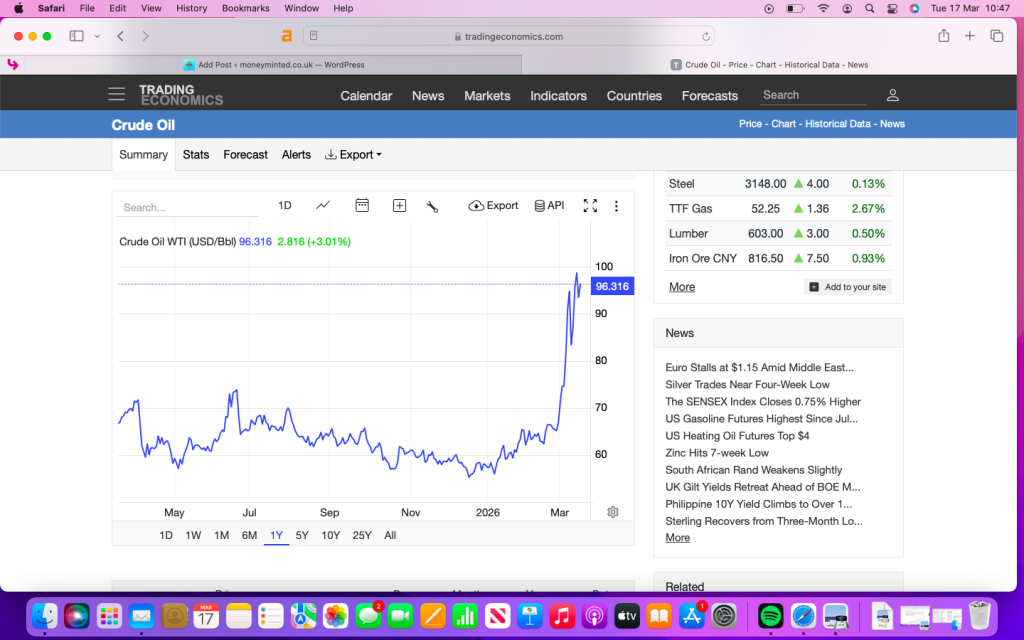
At present, each time the news is on each evening, they will show you a chart of the ever-changing oil price per barrel.
See chart for price over the past 12 months – now at nearly 100 USD per barrel.
Certain events will have both short term and long term effects on you individually and the economy as a whole. Which could last for a brief period or many years.
This could be through restricting supply chains, sudden surge in oil and commodity prices.
So petrol, heating costs, transportation costs become more expensive overnight.
But it will also create greater rate of inflation moving forwards, as the cost of good to transport and produce will normally become more expensive.
So to start off – what is market volatility ?
Volatility simply means how much quickly, and how much the price of an investment changes in the current period.
When market events appear volatile, price will move up and down dramatically.
But you shouldn’t worry, as it’s a natural event, primarily driven by economic or global events, and the sentiment in the market at that time.
Markets will always go up and down:
It’s only natural that markets across different countries, sectors and commodities will rise and fall as per investor sentiment.
It supposedly cleanses the market:
Any corrections can remove or weed out poor companies, or unhealthy assets and undue speculation. Which helps to improve the markets in future.
It could be an opportunity to take advantage of:
Although markets falls and price drops can be scary.
It also presents buying opportunities to purchase some good companies or assets at a reduced price.
If you hold them for many years, it could pay off very rewardingly.
Some simple examples:
- Between October 2007 to March 2009, (UK banking crisis), the FTSE 100 market fell by 45% and the S&P 500 almost dropped by half.
- During the COVID pandemic in 2020, in February and March the Uk market fell by 30%.
- We also seen markets fall as a result of Russia / Ukraine conflict.
- Even with the announcements of the US trade tariffs on Liberation day, the UK stock market fell by 10% in a week, but was still up by nearly 20% during 2025.
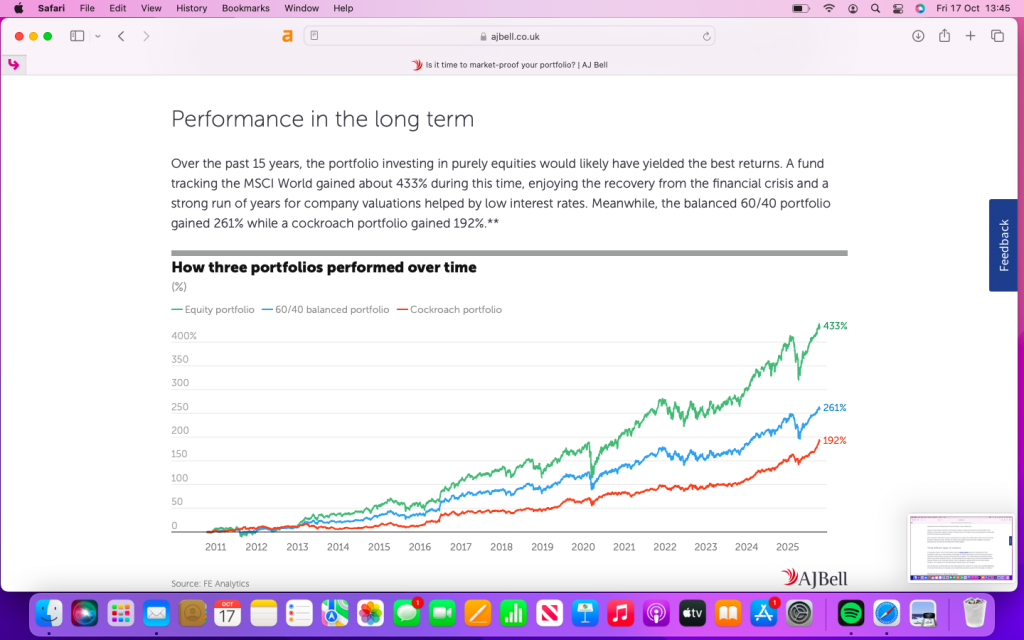
As we can see from the following charts, the marks will go up and down but over time will normally always provide positive returns.
To use the S&P 500 as simple rule of thumb, it has given annualised return of about 8 to 9% since inception in 1957.
So what can we do to remain calm !
- Avoid any emotional or knee jerk reactions.
Remember why you are investing in the first place, is it to grow assets, build wealth or improve your financial situation.
Don’t sell any investments at a loss based on short term market sentiment. the market will always recover.
You will have good months and bad months, where your portfolio will show some losses. But time in the the market will always beat trying to time the market.
As stated earlier the market returns nearly 10% each year over the long term.
2. Focus on your medium and long term goals
What are you medium plans and goals for for the next 5 years, or say the next 10 years being long term goals.
Is it to retire early, clear the mortgage earlier than expected, retire earlier than state pension age. Or pay for the children future education needs such as attending University.
You will never create so called wealth or financial freedom away from a job or employment by putting money away in a simple low risk cash account.
You have to be investing in quality stocks, companies funds, businesses etc to break out of that cycle.
Remember that investing, will always beat a simple cash account over the long term
3. Keep investing – no matter what happens
Not matter what happens in the short term, keep investing on a regular basis.
Whether its’ each pay day or the 1st of the month, so continue investing on a regular basis.
Not matter how small that amount is. It may be that you start off small say £ 25 or £ 50 each month and you increase that amount as you become more confident in investing.
I personally invest each month through payroll into a workplace pension.
Plus on the 1st of each month I will invest a set amount into my personal pension and stocks & shares ISA through simple automation.
This allows me to buy shares or funds dependant on the price. If the share price does go lower, it allows me to purchase more units for the same price.
So use the power of regular investing and compound that over time to grow your assets, or create a sizeable portfolio.
4. Avoid short term market noise
Learn to switch off from short term market noise, it’s only a distraction.
The news will be full of woe when markets do fall dramatically on any given day.
But it won’t let you know that the market has recovered and prospered over the prevailing months.
Stop looking at share prices of your portfolio every hour or several times a day.
It will only produce fear and give you undue worry and stress.
I personally read market news most days, but I will look at my portfolio at the end of each month, when I record it’s valuation.
Remember to stay relaxed and think long term.
It could be a double whammy if you do sell shares. There is a transaction or dealing cost, to buy sell and then possibly buy back in a later date.
So try to remain calm and focused and avoid any undue worry or transaction costs.
Also consider, where do you put those funds if you do decide to disinvest.
5. See it as a buying opportunity
If the market does fall significantly, could it be seen as advantageous and a good opportunity to buy shares, funds or assets at a discount.
You will be purchasing more units or shares for the same amount of money.
There’s a great saying “be greedy when other are fearful”, so can you take advantage of short term reduction in prices.
As we have seen during recent events, COVID, banking crisis, Russia / Ukraine conflict markets will soon recover in a vey short timeframe.
If you are prepared to think for the medium or long term period, it will pay off very rewarding.
As you have acted decisively, or remained calm. Others may decide to get back in the market some time later.
When that ship has already sailed and prices are now much higher to purchase.
6. Make sure you diversify.
If you are going to invest, remember to diversify across different asset classes. If you are just starting out you may stick to a simple ETF or global tracker, which will have low fees and cover most geographical locations.
I personally invest money into the Fidelity World Index fund (https://www.fidelity.co.uk/factsheet-data/factsheet/GB00BJS8SJ34-fidelity-index-world-fund-p-acc/key-statistics) which holds around 1300 holdings around the world. many other great low cost tracker funds will be offered by your investment provider or APP.
As you become more seasoned, and comfortable you may buy into individual shares, or sectors or specific countries.
But don’t buy just UK holdings or USA companies or funds.
Try and spend your assets across different sectors, countries asset classes. (i.e shares, funds, bond, commodities etc)
If 1 sector or country is severely affected in the short term.
It won’t have such a dramatic effect, to say have 20% in the UK, 50% in USA, 10% in Europe and 20% in Asia and Emerging markets.
Plus you won’t get every investment decision you may right, you will have some winners and losers.
Even the investment professionals make mistakes, but it’s how you react to those decisions will affect your attitude moving forwards.
Or how you make investment decisions in future years.
Hopefully, by considering the key points mentioned above you can eliminate short term investing mistakes.
So you can reach your medium and long term investment aims and goals.
Remember:
If you found this blog post useful and informative, please check my other posts on investing, pensions, investment books that I recommend on https://moneyminted.co.uk
So you can reach you investing goals and ambitions in future yers, the world of investing isn’t a get rich quick scheme, it should be safe and boring. But you will get their in the end if you think long term, invest on a regular basis and invest within tax-free wrappers.
Be the first to reply